

Technology
Leading the global power plant maintenance market with unrivaled technological capabilities
Specialized Technology
Large Rotating Machinery Maintenance and Balancing
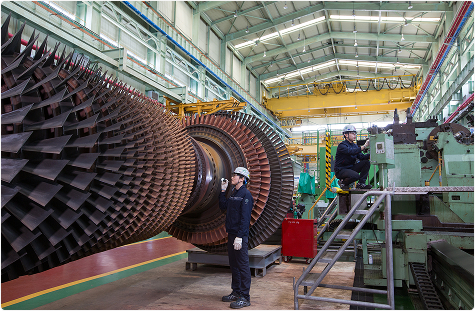
In 1997, the Power Maintenance Engineering Center completed the construction of its rotor maintenance shop. Since then, the Center has internalized and absorbed gas turbine rotor refurbishment technologies that had previously been performed only by certain manufacturers.
By also securing steam turbine rotor maintenance technologies, the Center now possesses the capability to provide integrated maintenance services for both components and rotors in the gas turbine maintenance field.
The rotor maintenance shop is equipped with advanced equipment required for the disassembly and inspection of large rotors, including large balancing machines, large lathes, and stacking/unstacking facilities.
The Center provides comprehensive rotor services, including wheel disassembly, replacement and inspection, coating repair, balancing, machining, and shot peening for rotors weighing close to 100 tons.
Major Services
Blasting
-
Dry Blasting
Dry blasting removes impurities such as scale and hard deposits formed on the rotor surface during operation by spraying aluminum oxide at high pressure together with compressed air.
Major areas such as wheel dovetails are cleaned using glass beads. -
Wet(liquid abrasive) Blasting
Wet blasting improves the surface friction of wheels to prevent slip between wheels, which may occur due to temperature gradients during operation.
Shot peening
Gas turbine rotors that have been operated for a certain period of time are vulnerable to damage caused by thermal fatigue or high-temperature thermal fatigue.
To prevent component damage, steel balls of a specified size are projected onto the rotor surface together with compressed air. This hardens the surface, improves fatigue strength, and introduces compressive residual stress on the rotor surface.
Rotor stacking & unstacking
When each stage of a damaged rotor needs to be disassembled, such as in disk-type rotors manufactured by GE or WH, the rotor, which consists of multiple wheels assembled with through bolts, is positioned vertically during unstacking and stacking work.
To ensure work efficiency, a hydraulic rotor stacking facility is installed around the rotor, allowing the work position to be adjusted freely as needed. This ensures both convenience and safety during maintenance work.
Turning, Grinding & Polishing
Turning, grinding, and polishing are performed for machining radial reference surfaces, rabbit fit dimensions, blade tenon sections and tips, journal surfaces, and thrust collar surfaces.
Turning using a cutting bite is applied for rough machining, grinding using a grinding stone is applied for finishing, and polishing using sandpaper and other materials is performed to achieve the required surface roughness.
Boring & Milling
Boring and milling are mainly performed for surface machining, hole machining, and inner and outer diameter machining of stationary components such as turbine diaphragms, journal bearings, and interstage seals.
Rough machining is performed using bites or cutters, while finishing is performed using grinding stones.
Balancing
During operation, rotating equipment may generate vibration due to centrifugal force caused by mass variation.
To minimize this vibration, balancing work is performed by measuring the amount of unbalance and phase angle, and then adding or removing the corresponding weight as needed.
Work Procedure
Incoming Inspection
TBN / Comp Rotor Separation and Inspection
Comp / TBN Wheel Separation and Inspection
Blade Removal
Machining
Wheel and Blade Inspection
Non-Destructive Examination(NDE)
Blasting and Cleaning
Blade Maintenance, Moment Weighing, Replacement and Assembly
Comp / TBN Wheel alancing and Assembly
Comp / TBN Wheel Balancing and Inspection
TBN / Comp Rotor Coupling and Various Inspections
Shipping
Packing
Unit Rotor Final Balancing and Run-Out Inspection
Journal and Thrust Collar Machining
Equipment
Engine Lathe(Large Size)
Engine Lathe(Medium Size)
Balancing M/C(Large Size)
Balancing M/C(Medium Size)
Stacking Facilities(Rotor Disassembly and Assembly Equipment)
Dry Blast & Shot Peening Booth and Machine
Major Achievements
Domestic
-
Seo-Incheon Combined Cycle Power Plant
Five Power Generation Companies
-
Shin-Incheon Combined Cycle Power Plant
Five Power Generation Companies
-
Ilsan Combined Cycle Power Plant
Five Power Generation Companies
-
Pyeongtaek Thermal Power Plant
Five Power Generation Companies
-
Ulsan Thermal Power Plant
Five Power Generation Companies
-
Other Steam Power Plants
Five Power Generation Companies
-

Gwangyang Steel Works, POSCO
-
Yeocheon NCC
-
Sithe Korea
Sithe Korea(Icheon Cogeneration and Daesan Combined Cycle)
-

Hyundai Petrochemical
-
Mok-dong and Nowon Cogeneration Plants
Mok-dong and Nowon Cogeneration Plants
Overseas
-
Navotas Power Plant
Navotas(Philippines)