

Technology
Leading the global power plant maintenance market with unrivaled technological capabilities
Specialized Technology
Industrial Cleaning
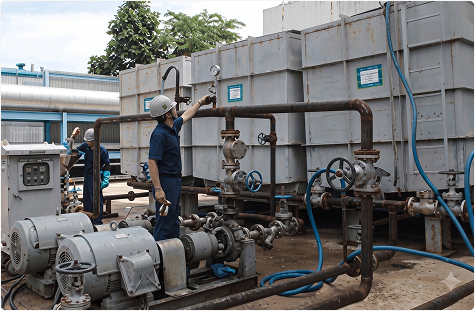
Since 1975, KEPCO KPS has performed engineering and construction services for industrial cleaning targeting KEPCO power generation facilities and industrial facilities in the refining and petrochemical sectors.
For each project, KEPCO KPS deploys engineers and operators with extensive theoretical knowledge and experience in chemical cleaning, together with the required equipment, to ensure the highest quality, best safety, and maximum efficiency for customers.
In addition, to promote business growth and strengthen external competitiveness in the era of unlimited competition in the 21st century, KEPCO KPS is working to establish an integrated execution system covering diagnosis, chemical prescription, construction, supervision, and evaluation for all cleaning services.
To achieve this, the company is modernizing equipment, securing outstanding personnel, establishing optimal cleaning processes, and operating its own laboratory for smooth research and analysis.
Major Services
- Cleaning of internal and external surfaces of boiler tubes
- PRE Cleaning of internal and external surfaces of boiler tubes
- Foam cleaning of condensers
- Cleaning of internal and external surfaces of various industrial facilities
External Tube Cleaning
On the external surfaces of boiler tubes at oil-fired power plants, sludge is generated from corrosion products such as sulfur and vanadium caused by heavy fuel oil.
This sludge obstructs the flow of exhaust gas and fluid, resulting in uneven heat absorption. As overheated areas occur, corrosion is further accelerated.
To remove slag attached to the external surfaces of boiler tubes, KEPCO KPS introduced and has performed jet cleaning since 1983.
Jet cleaning is a method that physically removes deposits using the impact energy generated when a mixture of water and cleaning chemicals is sprayed by a high-pressure pump at 70 to 100 kg/cm² and collides with the target surface.
Internal Tube Cleaning
To remove scale attached to the internal surfaces of boiler tubes, a cleaning method with low base metal corrosion and high safety is required.
In March 1987, KEPCO KPS sent employees to the Tsing Yi Power Station of China Light and Power Co., Ltd. in Hong Kong to acquire ACR, Alkaline Copper Removal, cleaning technology.
The ACR cleaning method removes iron oxide, copper, and other oxides attached inside tubes at the same time using a single chemical.
Compared with conventional acid cleaning, ACR cleaning can be completed in a shorter period of time. Since cleaning is performed in an alkaline solution, there is less concern about boiler tube corrosion than with acid cleaning. It also produces a smaller amount of remaining sludge and allows cleaning wastewater to be incinerated.
Using the acquired ACR cleaning method, KEPCO KPS jointly performed boiler cleaning for Seoul Thermal Power Plant Unit 5 with Dow Chemical of the United States and Ebara of Japan.
Since the boiler cleaning work for Bukjeju Unit 1 in March 1993, KEPCO KPS has performed this service independently.
Condenser Internal Cleaning
Scale is generated inside condenser tubes depending on the quality of cooling water, and most of this scale consists of organic substances and mud.
To remove this scale without damaging the tubes, KEPCO KPS introduced foam cleaning, a method developed in the 1990s by Dowell Schlumberger of the United States. This method creates foam by mixing a foaming agent with a cleaning solvent.
KEPCO KPS jointly performed foam cleaning for Incheon Thermal Power Plant Units 1, 2, 3, and 4 with Dowell Schlumberger of the United States in March 1990, and has performed the service independently since 1993.
Equipment
| Item | Specification | Quantity | Remarks |
|---|---|---|---|
| PUMP | 300 T/H × 150 M and 4 other types | 12 | |
| TANK | 200㎡, 102 | 5 | |
| JET CLEANER | 70 kg/cm² × 15 HP and 4 other types | 17 | |
| Other Equipment | 14 |
Major Projects
| Item | Earnings | |
|---|---|---|
| Number of Projects | Amount(KRW thousand) | |
| KEPCO Projects | 33 | 1,507,676 |
| External Projects | 6 | 250,900 |
| Total | 39 | 1,758,576 |