

Technology
Leading the global power plant maintenance market with unrivaled technological capabilities
Specialized Technology
Turbine Component Repair and Refurbishment
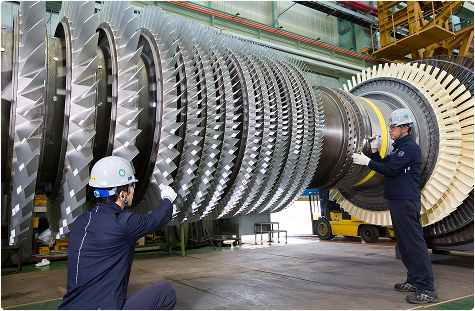
Gas turbine components for power generation, including buckets/blades, nozzles/vanes, transition pieces, combustion liners, and diaphragms, operate at temperatures exceeding 1,000°C.
As these components are used for peak-time load operation during periods of high electricity demand, various types of damage frequently occur due to repeated start-ups and shutdowns, including thermal fatigue, cracks, corrosion, and burnout.
To extend the service life of gas turbine components operating under such harsh conditions and maintain operating efficiency, periodic maintenance, repair, and refurbishment are essential.
The Power Maintenance Technology Center has established a comprehensive service system for the repair and manufacturing of power generation equipment components, including gas turbines and steam turbines. The Center is equipped with a wide range of maintenance technologies, including welding, machining, material analysis, shot peening, coating, and balancing, as well as advanced jigs and fixtures.
By providing specialized repair and refurbishment services for GE, Siemens, and MPW gas turbine models owned by Korea’s six power generation companies, POSCO, Korea District Heating Corporation, and independent power producers, the Center contributes significantly to extending equipment life and ensuring a stable power supply.
Major Services
Material Analysis and Measurement Testing
The Center operates a material analysis laboratory staffed by experts in the field of superalloys and performs life assessment and material analysis of turbine components and related parts.
Welding
High-temperature gas turbine components such as buckets/blades, nozzles/vanes, combustion liners, and transition pieces may experience cracks, wear, and fracture due to thermal stress, high- and low-cycle fatigue, and hot corrosion when operated for long periods at high temperatures or exposed to repeated start-up and shutdown cycles.
To restore damaged components to their original condition, welding and ADH are performed.
Materials used for gas turbine hot gas path components are mainly nickel- and cobalt-based superalloys designed to withstand high temperatures. Accordingly, welding work is mainly performed using GTAW, Gas Tungsten Arc Welding.
Depending on the material, the Center has been qualified by GE for approximately 40 welding procedures and maintains welding quality through periodic qualification evaluations.
Striping
Stripping is a process that removes existing coating layers without damaging the base material by using chemical and physical methods for damage inspection, refurbishment maintenance, and coating processes of gas turbine components.
The Center is equipped with systems such as a Metal Finish Waste Water Pretreatment System and an Air Scrubber System, and also focuses on purifying and discharging heavy metals and toxic gases emitted during the stripping process.
Coating
The efficiency of a gas turbine is determined by the expansion ratio of combustion gas, which is closely related to combustion temperature.
Recently developed gas turbines are designed to operate at ultra-high temperatures, and heat-resistant materials, superalloys, have been developed and used.
However, superalloys have already reached their limits in terms of high-temperature strength and high-temperature corrosion resistance.
As a countermeasure, the Center performs coating work for high-temperature corrosion prevention and thermal barrier protection.
Major coating methods include thermal spray coating and pack diffusion coating.
Machining and Balancing
Turbine components are mainly made of heat-resistant alloys with high-temperature strength, heat resistance, and corrosion resistance.
Therefore, selecting tools and equipment suitable for the characteristics of the material is very important in machining. Selecting machining conditions to achieve optimal production efficiency is also a key factor for successful machining.
The Center operates machine tools such as vertical and horizontal boring and turning mills, ultra-large lathes, grinding machines, electro discharge machines, and small- and medium-sized lathes and milling machines. It also has highly skilled technical personnel to operate this equipment.
Electro Discharge Machining
Electro Discharge Machining is a special non-traditional machining method that converts electrical energy into thermal energy to melt, evaporate, and remove material.
It is highly useful for machining difficult-to-cut materials such as superalloys without requiring high cutting resistance or power, and it is an essential machining method for final drilling work on gas turbine components.
The Center operates die sinking EDM and super drilling EDM equipment, which are currently used for cooling hole machining of stationary blades and rotating blades, as well as forming of three-dimensional curved surfaces.
The Center is also conducting research to apply this technology to high-precision micro deep-hole drilling.
Heat Treatment
In general, when metals are operated at high temperatures for long periods, the physical and mechanical properties and weldability of the base material deteriorate.
To restore these degraded properties and improve weldability, heat treatment is performed before and after welding and after coating.
Vacuum Furnaces : Under high vacuum conditions, vacuum furnaces provide a cleaning effect by removing foreign substances from component surfaces and microcracks. They also restore the material properties of components for reuse and are used for furnace brazing.
Electric Furnaces : Electric furnaces can perform heat treatment at temperatures up to 1,200°C under atmospheric or argon gas conditions. The maximum load size is approximately 1,800 × 1,800 × 1,800 mm.
Non-Destructive Testing
Through receiving and incoming inspection of maintenance components, the Center accurately identifies defect conditions before maintenance and provides data required to determine maintenance feasibility, maintenance scope, and reuse suitability.
In-process inspection and final inspection are performed to identify defects that may occur during the process of restoring the shape and material properties of components.
Non-destructive testing is carried out as an essential process to ensure maintenance reliability and maintenance quality.
Localization Manufacturing and Reverse Engineering
Through material analysis in the laboratory, three-dimensional measurement using CMM, and CAD systems, the Center performs reverse engineering across industrial fields, including gas turbines and power generation facilities.
It prepares precision drawings required for production and achieves import substitution and technological self-reliance through localization manufacturing of various turbine components.
(Siemens W501D5 high-temperature components such as 1st to 3rd stage blades, transition pieces, and combustor baskets)
- Obtained quality certification from the Ministry of Commerce, Industry and Energy (NT, EM): manufacturing of various gas turbine spare parts (GE, Siemens, Alstom)
Work Procedure
Incoming Inspection
Dimensional Check and Disassembly
Alumina Blasting
Coating Layer Removal
Life Assessment
Inspection
Defect Removal
Solution Treatment
Welding and Shape Finishing
Non-Destructive Testing
Coating
Solution and Age-Hardening Heat Treatment
Final Inspection
Precision Measurement
Equipment
Welding Equipment
WRAP Welding machine, ADH System, TIG & MIG Welding Machine, Spot Welding Machine
Machining Equipment
VBM, HBM, Milling Machine, EDM, Surface Grinding Machine, Engine Lathe
Heat Treatment Equipment
Vacuum Furnaces, Electric Furnaces, Dry Oven, Rapid Heating Furnaces
Coating Equipment
ATC Plasma System, ATC-DJ HVOF System, METCO AR-2000 Six Axis Articulated& Arm Robot, SULZER METCO 9M High Energy Plasma Spray System, SULZER METCO DJC Hybrid HVOF System, FANUC M701i Robot, Vapour Degreaser, Ultrasonic Cleaner, Mini Blast Machine, Electric Retort Type, Diffusion Furnace, Bucket Internal Packing Machine, Powder Dry Oven
Stripping Equipment
Bucket Stripping System, Acid Strip Line, Clean Line, Electro-Etch Line, Metal Finish Waste Water Pretreatment System, Air Scrubber System, Cabinet Blast Machine(dry type), Cabinet Blast Machine(wet type)
Cleaning Equipment
Combustion Liner Auto Blast Machine, Dry Blast&Shot Peening Machine, Blasting Cabinet, Liquid Abrasive Blast System, Ultra Sonic Cleaning System
Non-Destructive Testing Equipment
F.P.I (Zyglo) System, Red Dye Booth, X-ray Generator, Ultrasonic Flaw Detector, Ultrasonic Data Acquisition System, Ultrasonic Thickness Gauge, Eddy Current Tester, Magnetic Particle Tester, Visual Inspection System, Endoscope (Borescope)
Material Analysis Laboratory Equipment
SEM with EDX, MTS, Optical microscope, XRD, XRF, Durometer
Reverse Engineering Equipment
CMM(Coordinated Measuring Machine), CAD System, Various metal- testing equipments
Major Achievements
Power Generation Companies
- Pyeongtaek Thermal Power Plant
Pyeongtaek Thermal Power Plant
- Seo-Incheon Combined Cycle Power Plant
Seo-Incheon Combined Cycle Power Plant
- Shin-Incheon Combined Cycle Power Plant
Shin-Incheon Combined Cycle Power Plant
- Ilsan Combined Cycle Power Plant
Ilsan Combined Cycle Power Plant
- Bundang Combined Cycle Power Plant
Bundang Combined Cycle Power Plant
- Ulsan Thermal Power Plant
Ulsan Thermal Power Plant
- Hallim Combined Cycle Power Plant
Hallim Combined Cycle Power Plant
- Bucheon Combined Cycle Power Plant, currently LG Power
Bucheon Combined Cycle Power Plant, currently LG Power
- Anyang Combined Cycle Power Plant, currently LG Power
Anyang Combined Cycle Power Plant, currently LG Power
- Yeongwol Thermal Power Plant, closed in 1999
Yeongwol Thermal Power Plant, closed in 1999
- Gunsan Thermal Power Plant, closed in 1999
Gunsan Thermal Power Plant, closed in 1999
Industrial Facilities
- Korea Integrated Energy, formerly Hanwha Energy
Korea Integrated Energy, formerly Hanwha Energy

Hyundai Petrochemical
- Sithe Korea
Sithe Korea(Icheon Cogeneration and Daesan Combined Cycle)

Samsung General Chemicals

LG Petrochemical
- LG Caltex
LG Caltex

Gwangyang Steel Works, POSCO

SK Chemical